
Salvage/Adrift
Lewis Davidson+Kazuki Nishinaga
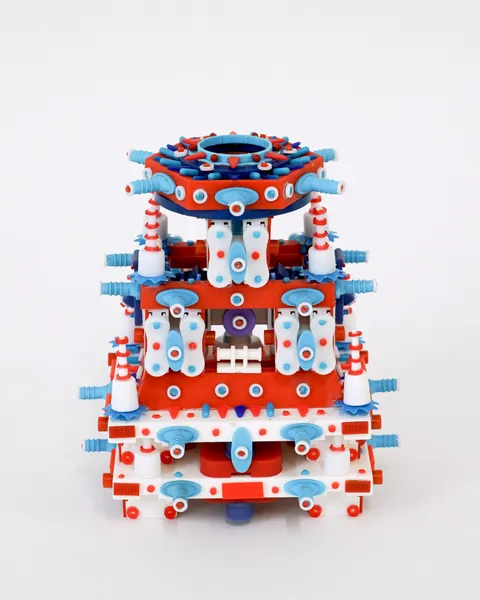
The title was decided among the three of us through conversation and, in the end, by email. I am deeply fond of it. It is a simple construction: two words—salvage and adrift—separated by a slash.
Lewis's practice begins with salvaging plastics destined for disposal. Kazuki's work, meanwhile, is typified by plaster adhering to a frame—evoking barnacles on a hull—an attempt to fix the process of deterioration itself into form.
We drift through this vast sea, breaking apart, washing ashore, perhaps becoming something else entirely. But perhaps I am already saying too much — reading into the work an image that belongs to me, not to them. Lewis was after something lighter.
In an email, Kazuki wrote of "foregrounding difference upon a shared foundation," and Lewis took to this immediately. It was less that we had reached an agreement than that we had found, in the slash between the two words, a meaning we could each hold on to.
We arrive here adrift, each from our own direction. Whether this is the process of building a single image, or the process of its continual dissolution, remains open.
Seiji Amashige(SPACE NOBI)
Artists
Lewis Davidson

Lewis Davidson (b.1990) lives and works in London. Spanning Sculpture, Animation, Sound, Photography and Installation, Davidson works with everyday materials in attempt to transform their ties to value, purpose and place. His practise plays a balance between engagement and escapism from the contemporary world. Solo and Duo Exhibitions include Electric Fall (Des Bains, London, 2025), KUNST-Stoff (University of St.Gallen, Switzerland, 2023), Shallow Haunts (Kupfer, London, 2023) and CLICKERS (Xxijra Hii, London, 2022). Davidson holds an MFA from the Slade (2017-19) with the addition of the Felix Slade Scholarship and Deans Bursary. Upon graduation he was awarded the Almacantar Studio Award and placed on the Deans List of Academic Excellence at UCL.
Davidson's work is part of the permanent collection at the University of St.Gallen, Switzerland.
https://www.lewis-davidson.com/
Kazuki Nishinaga (西永和輝)
Based in Tokyo. Sculptor. Graduated from the Department of Sculpture, Musashino Art University in 2016, and completed an MFA at the Slade School of Fine Art in 2019 (47th Scholar of the Ezoe Memorial Recruit Foundation; recipient of the Edward Allington Prize). His work focuses on the interface where artificial structures and organic forms, the designed and the time-worn, exist in a state of inseparable contact — giving shape to the imperfect translations that accumulate there. Recent exhibitions include "Rampant" (callbox, Tokyo, 2026) and "巣食ウ装飾(Nest-Infested Ornament)" (Gallery Binosya, Tokyo, 2022).
https://kazuki-nishinaga.jimdofree.com
The Cycle of Organization
—Lewis Davidson + Kazuki Nishinaga, Salvage/Adrift
Ryo Katsumata (Art Critic)
The title of this exhibition is formed by the combination of two English words: "salvage" and "adrift." The former refers to the recovery of discarded materials, or the rescue of vessels and the raising of sunken ships; the latter describes the state of a drifting boat. These two words do, in a sense, function as explanatory concepts linking the practices of Lewis Davidson and Kazuki Nishinaga. Looking back at their respective bodies of work, Davidson has often collected plastic fragments drifting through social space, reassembling them into unified objects. Nishinaga, meanwhile, has made sculptures that call to mind vessels hauled up after a long submersion. Yet the two artists' formal approaches are, at the same time, sharply contrasting.
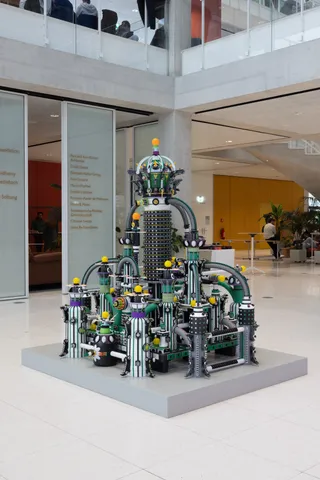
200x200x170cm, ©Lewis Davidson
It is telling that many of Davidson's assemblage objects made from plastic fragments belong to a series titled Clicker — a word denoting something that produces a clicking sound. This click acoustically marks a sequence of separation and joining: a pawl catches in a gear's tooth, is released by rotation, and engages the next. In Davidson's process, each plastic fragment is likewise detached from its original context and reattached to a new one — the sculptural object. The resulting work is assembled from parts with differing histories; color-differentiated to accentuate their distinctions, the components form a three-dimensional mosaic.
Through the procedures of assemblage, individual parts are incorporated into a whole. This unity is further reinforced by compositional symmetry — Davidson's objects typically possess such symmetrical structures, which lend them stable, heraldic, symbolic forms. One might think of the look of religious architecture or rationally engineered machinery. Yet symmetry also demands that identical parts be paired — the same element on the right and on the left. The social condition enabling this is an environment in which plastic products are industrially mass-produced and multiple identical units circulate. In this sense, Davidson's objects resemble nodes arising within a cycle of production, distribution, consumption, disposal, decomposition, recovery, and reuse — rather than finished products made for a specific purpose. As parts enter and exit this nodal object through separation and joining, the mosaic's configuration is suggested to be in constant flux. The chromatically differentiated parts invite this metabolic process of dissolution and reassembly.
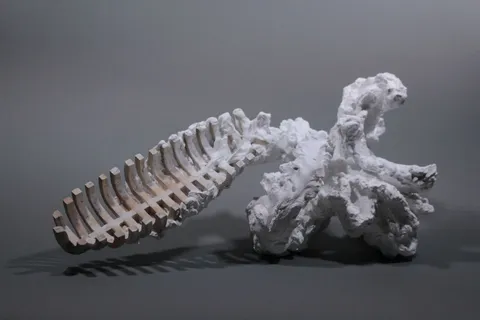
19x40x15cm, ©Kazuki Nishinaga
Davidson's objects are nodes within an economic cycle, and their own internal construction equally emphasizes clear articulation between parts — an articulation that makes the sharp compositional contrasts possible. Nishinaga's sculpture, for its part, also reveals an interest in nodes. But where Davidson clarifies the articulated structure of a composition, Nishinaga's procedures are directed toward its obscuration. This is evident in works that take the ship as motif. A hull reduced to its bare skeleton — keel and ribs exposed — renders structural articulation explicit. Yet, as if barnacles were not merely attaching to but consuming the vessel, amorphous masses of plaster encrust the skeleton, concealing the original structure beneath. "Plastic," in Davidson's work, refers to prefabricated industrial parts and guarantees the distinctness of one component from another; in Nishinaga's work, the word inverts into a description of material properties — pliable, malleable, resistant to articulation. Flexible materials such as plaster or clay generally give sculpture a continuous, unbroken surface, unlike constructivist work premised on differentiation between elements.
This interest in what covers structure connects to Nishinaga's broader concern with "decoration." But Nishinaga does not only cover structure from above — he also attempts operations that deform it from within, from the nodes that join one structural member to another. The adhesive medium that joins the parts of a hull is ordinarily invisible, quietly sustaining the stability of the structural frame. Nishinaga takes this subsidiary intermediary and amplifies it, allowing it to overflow from the joints. At that point the adhesive exceeds its original function and begins to behave in its own way.
From an engineering standpoint — from the standpoint of rationality in service of human activity — this incursion into articulated structure might be seen as destructive. But from another angle, a hull encrusted with barnacles is an environment reorganized into a habitat for creatures other than humans. An artifact, by coming into contact with things its maker never anticipated, gives rise to a different system. In this respect — and despite the contrasting approaches to articulation — Davidson's objects and Nishinaga's sculptures resonate. Just as the human idea of what a ship should be is unclear for barnacle’s sense, so too each piece of salvaged and reattached plastic has lost any clear sense of where it originally belonged. The blurred, indistinct silhouettes of things wavering in Davidson's lightbox works — so unlike his assemblage objects — might be understood as yet another expression of this indeterminacy.
Acknowledgments
Special thanks to Satoko Lee (Dededoko, Kodaira City) and Shotaro Yoshino (Artist, the BASES) for their cooperation and support in organizing this Artist-in-Residence program.
[Grants]
the Great Britain Sasakawa Foundation